Amazon OpenSearch Service
1. Overview & High-Yield Exam Context
Amazon OpenSearch Service is a fully managed search, vector, and analytics engine in AWS. Derived as an open-source fork of Elasticsearch (v7.10) and Kibana, OpenSearch plays two critical roles in the AWS MLA-C02 exam:
- Enterprise Search & Ingestion Engine: Indexing structured/unstructured documents for full-text search, filtering, and log analytics.
- Vector Database for RAG: Storing high-dimensional embeddings generated by LLMs (e.g., Amazon Bedrock Titan Embeddings) to enable semantic search and Retrieval-Augmented Generation (RAG).
2. Provisioned vs. OpenSearch Serverless
Understanding when to choose Provisioned Clusters versus OpenSearch Serverless is a frequent decision point on the exam.
| Dimension | Provisioned OpenSearch Domain | OpenSearch Serverless |
|---|---|---|
| Capacity Management | Manual configuration of Dedicated Master Nodes and Data Nodes (e.g., r6g.xlarge.search). |
Auto-scales compute capacity based on workload demand (measured in OCUs). |
| Storage & Compute Coupling | Bound to EBS volumes attached to specific data nodes (or UltraWarm). | Decouples compute from storage completely (data stored in managed S3 buckets under the hood). |
| Collection Types | Single domain handles search, analytics, and vector indexes together. | Optimized collections: Vector search, Timeseries, or Search. |
| Bedrock Knowledge Bases | Supported via custom cluster configuration and VPC endpoints. | Default native integration for automated zero-code RAG ingestion pipelines. |
| Best Used For | Predictable 24/7 workloads, precise cluster tuning, or existing Elasticsearch migrations. | Unpredictable traffic spikes, fast RAG prototyping, and zero-cluster-management architectures. |
3. Multi-Tiered Storage Architecture
To manage multi-terabyte search logs or historical customer tickets economically, OpenSearch uses a 3-tier storage architecture:
[ Hot Tier (NVMe / EBS) ] ──> [ UltraWarm Tier (S3 + Local Cache) ] ──> [ Cold Storage (S3 Detached) ]
  Fastest Query Latency           90% Cost Reduction                      Archival Only (Attach to Query)
-
Hot Tier (EBS / Instance Storage):
- High-performance SSD storage used for active indexing, frequent updates, and real-time k-NN vector searches.
- Exam Note: Vector indexes (HNSW) must reside in RAM on Hot data nodes for sub-second retrieval.
-
UltraWarm Tier (Amazon S3 + Caching):
- Uses S3 for persistent storage with local compute nodes for caching.
- Up to 90% cheaper than Hot storage.
- Ideal for read-only historical indexes (e.g., tickets or logs older than 30 days) that still need to be actively queryable.
-
Cold Storage:
- Fully detached indexes stored directly in S3.
- Does not consume cluster compute resources until explicitly attached to a domain for historical retrieval.
4. Vector Search & RAG Mechanisms
The k-NN (k-Nearest Neighbors) Engine
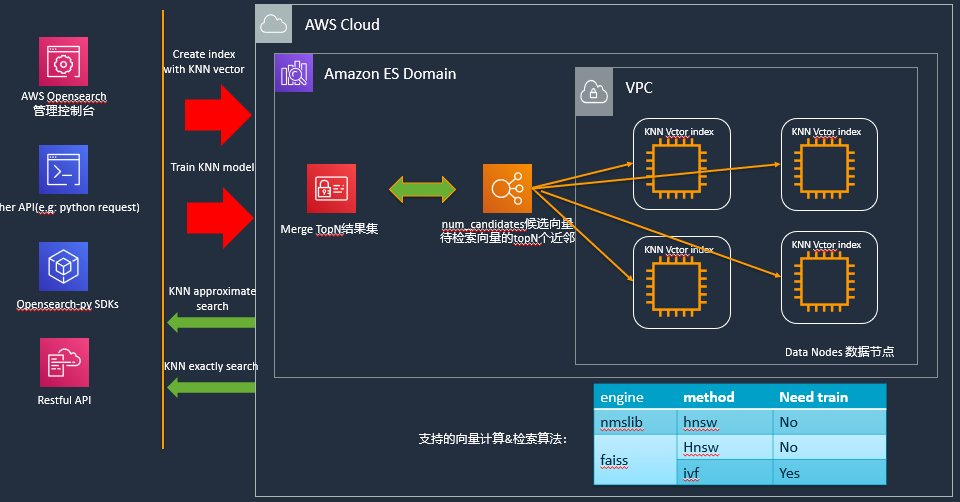
OpenSearch supports vector search via its native k-NN plugin. It supports two main index-building algorithms:
-
HNSW (Hierarchical Navigable Small World):
- Graph-based algorithm. Stored in memory (RAM).
- Characteristics: Extremely low query latency, high recall. Slower index build times and higher memory footprint.
- When to pick: Real-time user-facing RAG applications where latency is critical.
-
IVF (Inverted File):
- Partition-based algorithm.
- Characteristics: Reduced memory footprint and faster indexing, but lower recall precision than HNSW.
- When to pick: Massive datasets (tens or hundreds of millions of vectors) where RAM cost is the primary constraint.
Hybrid Search & Reciprocal Rank Fusion (RRF)
Vector embeddings capture semantic meaning, but struggle with exact keyword matches (e.g., product IDs, invoice numbers, or specific legal codes).
- Hybrid Search combines BM25 lexical keyword matching with HNSW dense vector search in a single query.
- Reciprocal Rank Fusion (RRF) combines the rank position of keyword search results and vector search results into a unified, balanced relevance score.
# OpenSearch Hybrid Search Query Structure
{
  "query": {
    "hybrid": {
      "queries": [
        { "match": { "ticket_text": "504 Gateway Timeout" } },  # Lexical Keyword Search
        {
          "knn": {                                             # Vector Semantic Search
            "ticket_vector": {
              "vector": [0.023, -0.114, 0.881, ...],
              "k": 5
            }
          }
        }
      ]
    }
  }
}
5. Bulk Ingestion & Extraction Patterns
Exporting Data (The 10k Limit)
By default, OpenSearch sets index.max_result_window = 10000. Standard from and size pagination fails when fetching deep data beyond 10,000 documents because the cluster must load and sort all preceding hits in heap memory.
- Bulk Extraction Tool: Use the Scroll API or **Point-in-Time (PIT) with
search_after**. - Why: Preserves a point-in-time search context on the data nodes, streaming millions of records sequentially without memory degradation.
Ingestion Pipeline Integration
- Amazon Bedrock Knowledge Bases: Automatically manages document parsing, chunking, embedding generation via Titan, and writing into OpenSearch Serverless.
- Amazon Kinesis Data Firehose: Streams log or metric data directly into OpenSearch with built-in retry logic and S3 backup for failed documents.
6. Security, Encryption & Compliance
- Encryption Policies (OpenSearch Serverless):
-
Encryption policies using AWS KMS Customer-Managed Keys (CMKs) must be created before creating the collection. They cannot be attached retroactively to an existing collection.
-
Fine-Grained Access Control (FGAC):
- Provides Document-Level Security (DLS) and Field-Level Security (FLS).
-
Allows masking sensitive columns (e.g., redacting credit card numbers or PII) based on IAM user role.
-
VPC Endpoints:
- Keep OpenSearch domain traffic entirely on private subnets without traversing the public internet.
7. MLA-C02 Exam Decision Matrix
| Scenario Requirements | Correct AWS Solution |
|---|---|
| Need a vector store for Bedrock RAG with zero infrastructure management | OpenSearch Serverless (Vector Collection) |
| Querying unstructured notes and searching for exact part serial numbers | Hybrid Search (BM25 + k-NN with RRF) |
| Need to query 3-year-old ticket logs cost-effectively without loading into RAM | UltraWarm Tier |
| Exporting 10M documents from OpenSearch to S3 to build a training set | Scroll API or Point-in-Time (PIT) API |
| Encrypting vector embeddings at rest with a custom key | OpenSearch Serverless with KMS CMK Encryption Policy |
8. Sample Exam Practice Questions
Question 1 (Multiple Choice)
An ML team has a 500 GB OpenSearch Service domain containing 20 million customer resolution documents. They need to extract all 20 million documents into an Amazon S3 bucket to fine-tune a domain-specific LLM. Standard search requests fail when paginating past 10,000 records.
Which approach is the most efficient and reliable for performing this extraction?
- A) Increase the
index.max_result_windowparameter to 20,000,000 and run standardfrom/sizequeries. - B) Use the OpenSearch Scroll API or Point-in-Time (PIT) with
search_afterto iterate through the dataset. - C) Query the OpenSearch domain using Amazon S3 Select directly from the AWS Management Console.
- D) Attach an Amazon EFS file system to the OpenSearch data nodes and copy the Lucene index files directly.
Click to reveal Answer & Explanation
Correct Answer: B
#### Correct Option Analysis

* **B is Correct:** The **Scroll API** (or Point-in-Time with `search_after`) creates a persistent search context that allows streaming millions of documents from OpenSearch sequentially without loading all results into RAM or hitting the 10,000 document window cap.

#### Distractor Analysis

* **A is Incorrect:** Increasing `index.max_result_window` to 20 million will cause extreme heap memory pressure and crash the OpenSearch cluster data nodes.
* **C is Incorrect:** Amazon S3 Select queries files stored inside S3 buckets (CSV, JSON, Parquet), not indexes inside an OpenSearch domain.
* **D is Incorrect:** OpenSearch manages storage internally via EBS or S3 storage tiers; Lucene index files cannot be mounted or extracted via EFS.
Question 2 (Multiple Response — Select TWO)
An AI engineer is setting up a Retrieval-Augmented Generation (RAG) knowledge base using Amazon Bedrock and Amazon OpenSearch Serverless. The solution must fulfill two strict security and operational constraints:
- All vector data stored in OpenSearch Serverless must be encrypted at rest using an AWS KMS customer-managed key (CMK).
- The document parsing, semantic chunking, and embedding generation from S3 files must run automatically without writing custom parsing code or managing Lambda functions.
Which TWO actions should the engineer take? (Select TWO)
- A) Define an OpenSearch Serverless encryption policy specifying the KMS CMK before creating the vector collection.
- B) Create an S3 Event Notification to trigger a Python script running on AWS Lambda to parse PDFs and push embeddings to OpenSearch.
- C) Create a Bedrock Knowledge Base pointing to the S3 bucket and trigger a synchronization job (
StartIngestionJob). - D) Configure Bedrock Guardrails to encrypt all text chunks before sending them to OpenSearch Serverless.
- E) Enable SSE-S3 default bucket encryption on the source S3 bucket to automatically encrypt the OpenSearch collection.
Click to reveal Answer & Explanation
Correct Answers: A and C
#### Correct Options Analysis

* **A is Correct:** OpenSearch Serverless encryption policies must be defined and associated *prior* to collection creation to enforce KMS CMK encryption at rest.
* **C is Correct:** Amazon Bedrock Knowledge Bases handles document ingestion, parsing, chunking, Titan embedding generation, and writing to OpenSearch Serverless as a fully managed service (`StartIngestionJob`).

#### Distractor Analysis

* **B is Incorrect:** Writing custom Lambda parsing scripts adds unnecessary operational overhead compared to Bedrock's native ingestion pipeline.
* **D is Incorrect:** Bedrock Guardrails handle safety filtering, toxic content blocking, and PII redaction—not database encryption.
* **E is Incorrect:** SSE-S3 encryption only secures data residing inside the S3 bucket, not the index inside OpenSearch Serverless.